

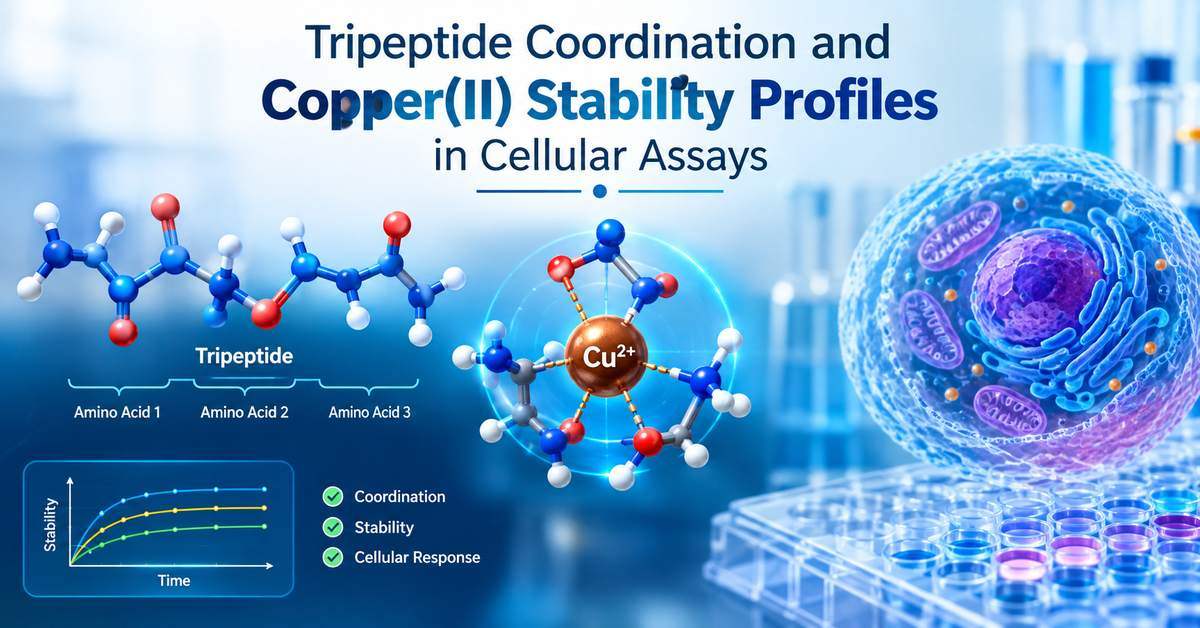
Structure and Coordination Chemistry of the GHK-Cu Tripeptide
The naturally occurring tripeptide glycyl-L-histidyl-L-lysine (GHK) possesses an extraordinary affinity for transition metal ions, particularly divalent copper (Cu2+). Discovered as an active plasma fraction that modulates cellular growth, collagen remodeling, and gene expression, the GHK-Cu complex exhibits high thermodynamic stability under physiological conditions. Understanding the coordination geometry, conformational dynamics, and solution behavior of this metallopeptide is fundamental for designing reproducible in vitro cellular assays and elucidating its broader biochemical mechanisms.
Molecular Geometry and Chelation Mechanics
In aqueous solution, the binding of Cu(II) to the GHK backbone proceeds through a distinct square-planar coordination sphere. High-resolution spectroscopic investigations, including electron paramagnetic resonance (EPR) and X-ray absorption fine structure (XAFS), demonstrate that Cu(II) coordinates with three nitrogen donors from the peptide backbone and one oxygen or solvent molecule:
The primary amino nitrogen atom at the N-terminal glycine residue
The deprotonated amide nitrogen of the glycyl-histidine peptide linkage
The imidazole nitrogen (N-delta or N-epsilon) of the central histidine side chain
An apical water molecule or carboxylate oxygen atom completing the coordination sphere
This distinct chelation arrangement yields an exceptionally stable coordination complex with an apparent binding constant (log K) of approximately 16.4. This elevated affinity allows GHK to effectively compete for Cu(II) ions in biological fluids without inducing non-specific oxidative damage associated with unchelated, free redox-active copper species.
Synthetic Protocols and Solid-Phase Assembly
Producing high-purity GHK requires rigorous synthetic methodology to ensure complete chelation competence. Standard solid-phase peptide synthesis (SPPS) utilizes base-labile Fmoc-protected amino acids assembled on acid-cleavable resins. The histidine residue requires orthogonal side-chain protection, such as trityl (Trt), to prevent premature coordination or unwanted branching during coupling cycles. Following global cleavage and scavenger addition, purification via reverse-phase high-performance liquid chromatography (RP-HPLC) isolates the uncoordinated GHK apo-peptide with purity profiles routinely exceeding 98%.
The subsequent complexation phase demands stoichiometric addition of high-purity copper(II) salts, typically copper(II) chloride or copper(II) acetate, in buffered neutral media. Precise stoichiometric titration prevents excess uncoordinated copper from remaining in the final product matrix. Standardized laboratory protocols detailing GHK-Cu laboratory synthesis emphasize rigorous pH monitoring during chelation, as protonation of the histidine imidazole ring below pH 5.5 causes reversible dissociation of the central metal ion.
Stability Profiles in Cellular Media and In Vitro Assays
When applying GHK-Cu in cell culture assays, stability in biological media is a key experimental consideration. Cell culture media containing fetal bovine serum (FBS) introduce abundant serum albumin and amino acids like histidine and cysteine, which possess competitive copper-binding affinities. Comparative binding studies confirm that although albumin binds Cu(II) with high affinity, GHK-Cu maintains steady-state equilibrium, permitting controlled copper delivery and cellular uptake via copper transport protein 1 (CTR1) and receptor-mediated endocytic pathways.
Furthermore, the redox activity of the bound Cu(II) is tightly moderated by the square-planar tripeptide cage. Unlike unchelated copper, which can participate in Fenton-like reactions to generate toxic hydroxyl radicals, the GHK-Cu complex functions as an effective antioxidant by scavenging free radicals, quenching lipid peroxidation, and upregulating endogenous antioxidant enzymes such as superoxide dismutase (SOD) in cultured fibroblasts and endothelial cells.
Analytical Verification and Purity Assurance
Characterizing the metallopeptide requires a combination of optical, mass, and spectroscopic techniques. Ultraviolet-visible (UV-Vis) spectrophotometry displays a characteristic absorption maximum near 640 nm, corresponding to d-d electronic transitions within the copper coordination field. Matrix-assisted laser desorption/ionization mass spectrometry (MALDI-TOF-MS) and electrospray ionization mass spectrometry (ESI-MS) verify intact molecular ions corresponding to the [GHK+Cu(II)-2H+H]+ species.
Furthermore, inductively coupled plasma mass spectrometry (ICP-MS) provides precise quantitative determination of copper-to-peptide stoichiometry, ensuring that no excess free copper or uncomplexed peptide persists. These combined analytical standards guarantee consistent experimental potency and structural reproducibility across modern biomedical and biochemical investigations.
[…] platforms like goralblue com serve as dynamic digital knowledge libraries. Online tech portals publish fast, searchable tutorials that help users troubleshoot operating system errors, discover […]